
Take off, Hover, and Landing (THL)

Introduction
WindShape, is at the leading edge of indoor Testing, Inspection, Validation, and Certification (TIVAC) for Unmanned and Advanced Aerial Mobility (AAM) systems. We proudly offer the integration of the Take-off – Hover – Landing (THL) assessment into our extensive TIVAC protocols. Building upon the insights capture from the WindShape Failure Mode and Effects Analysis (FMEA)—a systematic, step-by-step approach for identifying possible failures in a design, a process, or a product—the THL process is as a critical next step to validating an unmanned aircraft and/or system for safe and reliable flight. The FMEA helps enables the TIVAC process by prioritizing potential problems based on their impact, allowing for targeted improvements. The follow-on THL testing marks a significant (r)evolution in our methodology. It will enhance the operational understanding and system reliability for manufacturers, operators, and regulators. The THL offering underscores our commitment to advance aerial mobility and UAS through meticulous testing and validation, ensuring that the highest standards of safety and performance are realized before entering the National Airspace System (NAS).
The Essence of THL
The Take-off, Hover, Landing (THL) test procedure is a rigorous evaluation framework designed by WindShape. It examines Unmanned Aerial Systems (UAS) under challenging environmental conditions. This process focuses on assessing the UAS’s stability and resilience, during critical flight phases—take-off, hovering, and landing—against wind perturbations and other environmental factors. The procedure is predictively structured to ensure UAS compliance with regulatory standards, addressing both operational safety and design efficacy. By simulating real-world flight conditions, within a controlled repeatable laboratory; the THL tests provide invaluable data for refining UAS capabilities, enhancing operational reliability, and supporting continuous design improvement. This comprehensive approach not only helps manufacturers to optimize quality, but it also ensures that operators can achieve higher safety and efficiency standards, all while adhering to regulatory compliance and fostering a culture of predictive problem solving within the aerial mobility sector. The THL process, building on insights from the FMEA, offers distinct benefits across all areas of operation.
Manufacturers' Benefits
- Quality Improvement – THL testing enables manufacturers to pinpoint and resolve potential design flaws during critical flight phases; ensuring products meet the highest standards
- Cost Reduction – By identifying issues early, manufacturers can avoid costly recalls and repairs, saving significant resources
- Performance Insights – Detailed data from THL tests offer insights into how drones perform under various conditions, guiding smarter design choices.
Operators' Benefits
- Quality Improvement – THL testing enables manufacturers to pinpoint and resolve potential design flaws during critical flight phases; ensuring products meet the highest standards
- Cost Reduction – By identifying issues early, manufacturers can avoid costly recalls and repairs, saving significant resources
- Performance Insights – Detailed data from THL tests offer insights into how drones perform under various conditions, guiding smarter design choices.
Regulators' Benefits
- Compliance Assurance – THL testing provides a structured framework for assessing drone safety, and aids in regulatory compliance.
- Oversight Efficiency – With access to THL test data, regulators can validate that drones meet safety standards, streamlining the oversight and accelerating the certification process.
- Public Safety – By ensuring drones undergo thorough testing, regulators help enhance public trust in drone technology, promoting wider acceptance and use.
In summary, transitioning from FMEA to THL testing represents a significant (r)evolution in the safety and reliability assessment of Unmanned Aerial Systems and Advanced Aerial Mobility aircraft.
Process
The THL process, enhanced by WindShape’s innovative ‘Windshaper’ technology, represents a comprehensive approach to UAS testing across take-off, hover, and landing phases.
Take-off Phase (TOP)
The ‘TOP’ incorporates WindShape’s proprietary Fan-Array Wind Generators (called the ‘WindShaper’). This test simulates complex wind patterns and gusts, offering a realistic repeatable free-flying assessment of a UAS’s ascent capabilities. This technology allows for precise control over wind conditions, and data capture; ensuring the safety and reliability of take-offs in urban and rural environments.
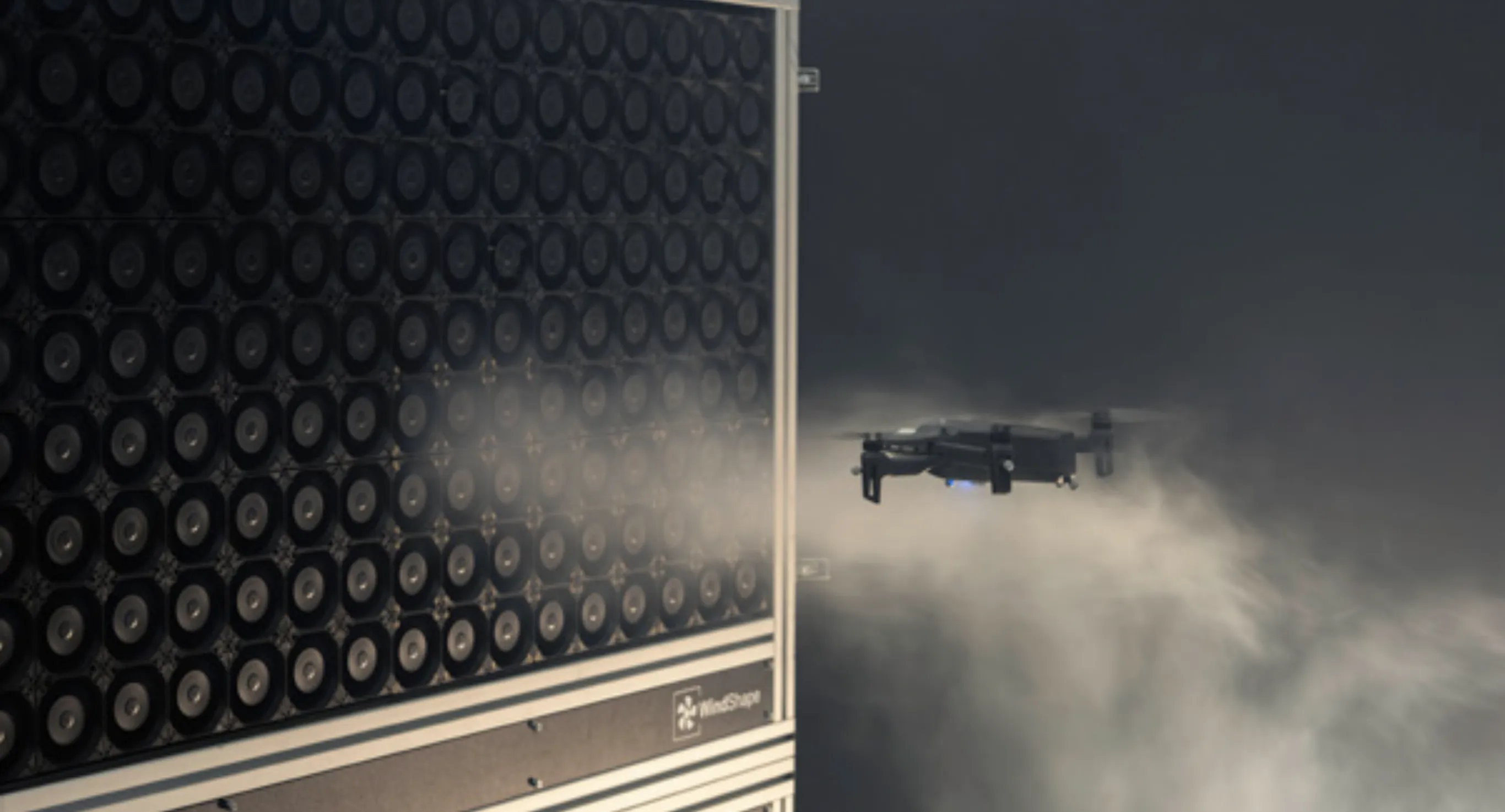
A ‘TOP’ Test Example
- Wind Resistance Test – Evaluates the UAS’s capability to ascend under varying wind intensities, mimicking real urban gust conditions.
- Vertical Ascent Efficiency – Measures how efficiently a UAS can ascend, taking into account energy consumption and stability in fluctuating wind conditions.
Hover Operating Phase (HOP)
Utilizing the ability to create variable and turbulent airflows, hover tests evaluate the UAS’s stability and energy efficiency. This phase benefits from WindShape’s capability to replicate real-world environmental conditions, providing manufacturers and operators with valuable data on performance and design optimization.
A ‘HOP’ Test Example
- Turbulence Stability Test – Assesses the UAS’s ability to maintain a stable hover in turbulent airflows, replicating unexpected wind shifts.
- Hover Endurance Test – Determines the duration a UAS can hover while subjected to random wind patterns, focusing on battery efficiency and control mechanisms.
Landing Operating Phase (LOP)
Focused on the UAS’s descent and touchdown, this phase leverages the Windshapers precision to test landing accuracy and stability under challenging wind and environmental conditions. WindShape’s technology flexibility in simulating diverse wind scenarios ensures that UAS can safely land in close proximity to people and structures.
A ‘LOP’ Test Example(s):
- Precision Landing Test – Measures the accuracy of UAS landings under simulated wind gusts, ensuring safe touchdown in designated areas.
- Landing Stability in Wind Shear – Evaluates the UAS’s ability to remain stable and control descent speeds when experiencing sudden changes in wind speed and direction.
Each phase, is enhanced by WindShape’s Fan-Array Wind Generators, real-weather generators, and a close-loop data-capture environment ensuring precise simulation and data capture of real-world urban and rural flight conditions. This provides quality validated data-in so that you can make quality decisions to improve UAS and AAM safety, efficiency, and regulatory compliance.
Deliverables
The WindShape deliverables are designed to outline the specific outcomes and relevant data that will be provided to the manufacturers, operators, and regulators following the THL testing procedure(s). The WindShape deliverables will ensure that all stakeholders receive comprehensive, actionable insights localized for your needs. With a focus on enhancing UAS safety, efficiency, and compliance, the deliverables include detailed reports, operational guidelines, compliance documentation, and data sets in industry- standard formats; providing a foundation for continuous improvement and innovation across the aerial mobility industry. Here’s some examples of those deliverables:
For Manufacturers
- Aerodynamic Data Sets – Comprehensive datasets including wind resistance, propulsion efficiency, and stability metrics, provided in formats compatible with engineering software for further analysis
- 3D Flow Visualization Files – Detailed visualizations of airflow around the UAS during different test phases, useful for design optimization.
For Operators
- Operational Telemetry Logs – Detailed flight logs capturing key performance indicators like battery efficiency, hover stability, and control responsiveness under simulated environmental conditions.
- Safety Audit Trails – Documented evidence of all safety checks and test outcomes, formatted for easy integration into operational safety management systems.
For Regulators
- Compliance Matrix Documentation – Cross-referenced data showing test conditions, outcomes, and compliance with specific regulatory standards, provided in standard formats for regulatory review
- Risk Analysis Models – Detailed models estimating potential operational risks based on test data, supporting the development of safety regulations and guidelines.
These data deliverables, provided in formats localized to each stakeholder’s platforms, ensure that all parties have the precise information needed to make informed decisions about UAS design, operation, and regulation.
Your Partner in Excellence
The THL TIVAC PRIMER is intended to encapsulate encapsulates the essence of the WindShape innovative approach towards enhancing the safety, efficiency, and compliance of Unmanned and Advanced Aerial Systems. Through the precise Take-off, Hover, Landing TIVAC process, empowered by the state-of-the-art Windshaper technology, we offer manufacturers, operators, and regulators—comprehensive actionable insights into UAS and AAM performance under varied flight and environmental conditions, that are repeatable. The detailed deliverables, including aerodynamic datasets, operational guidelines, and compliance documentation, are localized to meet the specific needs of each stakeholder; ensuring the continuous improvement in unmanned advanced aerial technology and systems that plan to operate in the National Airspace System.
Frequently Asked Questions (FAQs)
What does THL testing involve?
THL (Take-off, Hover, Landing) testing assesses a drone’s performance across three critical flight phases under various environmental conditions to ensure safety and reliability.
Why is THL testing important for UAS development?
It provides valuable insights into the operational capabilities and limitations of drones, enabling manufacturers to enhance design, safety, and compliance with regulatory standards.
How does WindShape’s technology improve THL testing?
WindShape utilizes advanced Fan-Array Wind Generators to simulate real-world atmospheric conditions more accurately, offering a unique advantage in aerodynamic testing
Can THL testing predict how drones will perform in urban environments?
Yes, by replicating complex urban wind patterns and turbulence, THL testing can predict drone behavior in city settings, enhancing operational planning and safety.
What are the deliverables from a THL test?
Deliverables include comprehensive performance reports, aerodynamic data sets, operational guidelines, and compliance documentation tailored for manufacturers, operators, and regulators.
How can operators and regulators use THL test results?
Operators can optimize maintenance and operational strategies, while regulators can ensure drones meet safety standards, facilitating oversight and enhancing public trust in drone technology.