

Propeller Icing Test


Abstract
Among the list of harsh conditions, icing is certainly the most critical. The authors present an exploratory work to develop a method for characterizing the performances of propeller in laboratory icing conditions. This research was enabled by the use of a climatic chamber featuring an array of water nozzles that makes it possible to generate icing condition, in combination with a windshaper – a new family of wind-generating facilities, which consists of an array of a large number of fans (wind-pixels) that can be activated on demand to generate arbitrary winds of variable intensity and directions, such as uniform flows, gusts, or shear flows. Propellers were characterized with a test bench capable of measuring the thrust, motor torque, motor speed, electrical power and the weight of accreted ice.
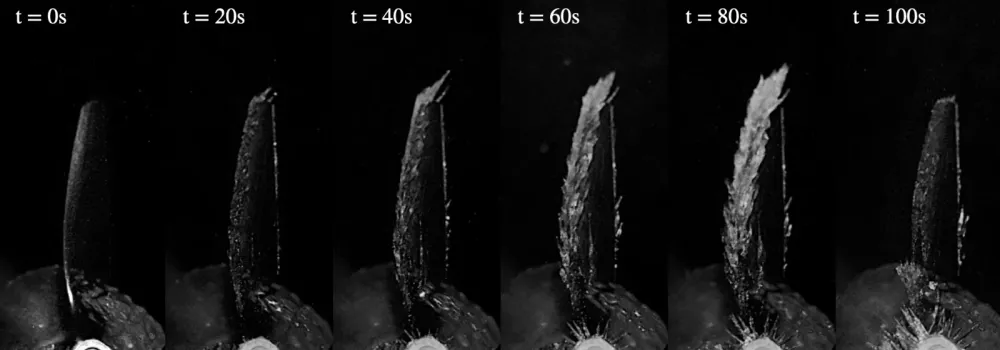
Additionally, the room temperature, humidity and wind speed were also monitored separately. A visual analysis of the accretion of ice on the propeller that was made using short-duration flash lamps and a camera, allowed to correlate the performance drop with proportion and morphology of the accreted ice on the propeller. The authors finally provide their observations for a selection of test results.
Presentation of the test setup
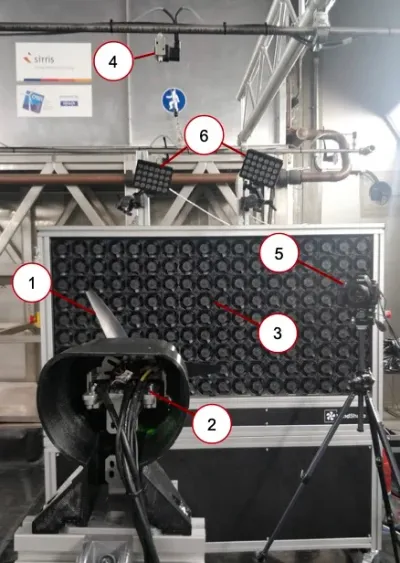
The test setup includes :
- Propeller, 3 blades, 9 inch in diameter, 5-inch pitch (HQProp MacroQuad 9x5x3)
- Test stand for propulsion units – RCbenchmark 1585 by Tyto Robotics
- 1.5m x 0.75m windshaper that comprises 162 wind pixels arranged in an array of 6×3 modules
- Water spray device – custom build by Sirris
- Canon 5D Mk2, a full frame digital SLR camera, set at 6400 ISO, mounted with a 80mm f/1.8 lens set at maximum aperture
- Short duration scientific strobe light (Visinst VIC 4×6 LED Array)
This is a joint research project between WindShape, Sirris, and HES-SO which was also supported by Tyto Robotics.
Link to the journal (AIAA Aviation Forum 2021) https://arc.aiaa.org/doi/abs/10.2514/6.2021-2677